T3 answers
Algebra
Fall 2001
MATH 121-11
Instructions: Answer all problems correctly. NO CALCULATORS! Each numbered problem is worth 10 points unless otherwise specified. Each st*rred problem is extra credit, and each * is worth 4 points.
- Use synthetic division to write the rational function
in the form
where q(x) is a polynomial and where the degree of r is less than the degree of d. Note: Be particularly careful on this problem and the next, as you can make use of your result on a subsequent problem.
First, you need to rewrite the function as
and also keep in mind that
as you need the 0 as a place-holder. Here's the synthetic division tableau:
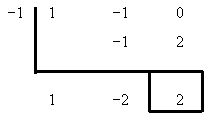
The result is that
- Use polynomial long division to write the rational function
|
f(x) = |
x2 (x + 2)
(x + 1)2
|
|
|
in the form
where q(x) is a polynomial and where the degree of r is less than the degree of d.
First, you need to rewrite the function as
|
f(x) = |
x3 + 2x2
x2 + 2x + 1
|
. |
|
Then long division gives us
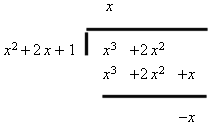
Thus,
|
f(x) = x + |
-x
x2 + 2x + 1
|
= x - |
x
(x + 1)2
|
. |
|
- Do one (and only one) of the following.
- (15 points) Neatly sketch the graph of the function in problem #2.
Looking at the formula obtained in problem #
2,
|
f(x) = |
x2 (x + 2)
(x + 1)2
|
= x - |
x
(x + 1)2
|
. |
|
we see that
f(
x) has an oblique asymptote of
y =
x. (This is the quotient,
q(
x), in that problem. We also see that there must be a vertical asymptote of
x =
-1 and two zeros, one at
x = 0 the other at
x =
-2, these being most easily seen from the factored form of the function. (The zero at
x = 0 has degree 2, so the local behavior will be parabolic and the graph won't change sign there.)
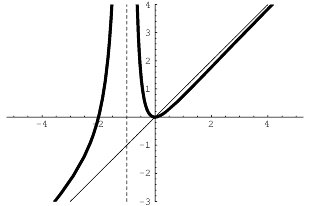
- (10 points) Neatly sketch the graph of the function in problem #1.
Be sure to clearly make your own x- and y-axes.
Whichever function you choose, be sure to list all asymptotes and zeros (if any) of the function.
The function
|
f(x) = |
x (x - 1)
x + 1
|
= x - 2 + |
2
x+1
|
|
|
has an oblique asymptote of
y =
x - 2, zeros at
x=0 and
x=1, and a VA at
x =
-1.
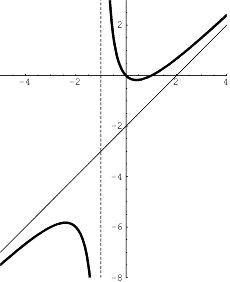
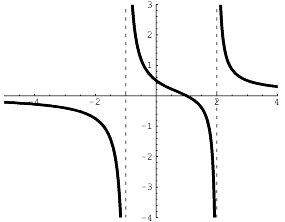
- (7 points) Neatly sketch the graph of the function
The degree of the numerator is less than that of the denominator, so we'll have a horizontal asymptote at
y = 0. We have a zero at
x = 1 and VA's at
x =
-1 and
x = 2.
- For the function f(x) you selected in problem #3, solve the inequality f(x) £ 0.
Just looking at the graphs gives us everything; just select the intervals where the function lies on or below the
x-axis.
- The solution set is {x £ -2 or x = 0}.
This can be written as [-¥, -2] È{0}.
- {x < -1 or 0 £ x £ 1} = (-¥, -1) È[0,1].
- {x < -1 or 1 £ x < 2} = (-¥, -1) È[1,2).
- List all of the possible rational zeros of the polynomial
(If you're wondering, ``What's a?'' then you shouldn't be.)
The
a has nothing to do with it, as we need only consider the first and last coefficients. (Actually, I should have said that
a is a real number.) The possible rational seros are
|
± |
{1,2,3,6}
{1,7}
|
= ±{ 1, 2, 3, 6, 1/7, 2/7, 3/7, 6/7 } |
|
- Construct a polynomial of degree three with zeros at x=-1, x=-2 and x=3 and having a y-intercept of -12.
Having degree three and those zeros means the polynomial has
x+1,
x+2 and
x-3 as its only factors. So it must be a multiple of the product of those. Thus it must be
|
p(x) : = A(x+1)(x+2)(x-3) |
|
for some constant
A. having a
y-intercept of
-12 is equivalent to having
Therefore,
|
p(0) = A(0+1)(0+2)(0-3) = -12, |
|
or
hence
A = 2 and
Some of you thought it was necessary to expand the polynomial. In that case,
|
p(x) = 2(x3 - 7x - 6) = 2x3 - 14x - 12. |
|
- By some miracle, you know that 1-2i is a zero of the polynomial
Find all the other zeros of P(x).
Since 1
-2
i is a zero and since the polynomial has only real coefficients, we know by the Conjugate Zeros Theorem that the conjugate 1+2
i is also a zero. We can use synthetic division to divide out the factors corresponding to these zeros:
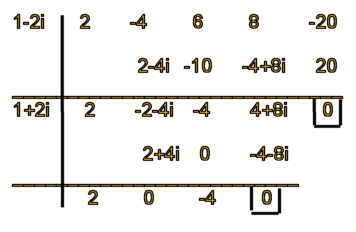
The zeros of the quotient, 2
x2 - 4, can easily be found to be
x =
±Ö2.
So the zeros of the polynomial are
|
{1 + 2i, 1 - 2i, Ö2, -Ö2 }. |
|
Note: There is another trick for reducing the polynomial using long division instead of synthetic division.
Since we know the two complex zeros 1
±2
i, we know that the following polynomial is a factor:
|
(x - (1+2i)) (x - (1-2i)) |
|
|
|
((x-1) - 2i) ((x-1) + 2i) |
| |
|
| |
|
|
|
So divide
|
|
2x4-4x3+6x2+8 x-20
x2 -2x + 5
|
|
|
using long division, and you'll get 2
x2 - 4.
- Factor the following polynomial completely.
The only possible rational zeros are
±1, so checking is easy.
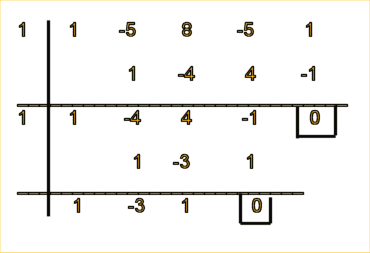
Therefore,
|
x4-5 x3+8 x2-5 x+1 = (x - 1)2 (x2 - 3x + 1). |
|
If you stopped there, I gave 7 or 8 points, depending on my mood at the time. But this can now be reduced further using the quatratic formula, which gives
as the zeros of
x2 - 3
x + 1. So the complete factorization is
|
x4-5 x3+8 x2-5 x+1 = (x - 1)2 |
æ
è
|
x - |
3 + Ö5
2
|
ö
ø
|
|
æ
è
|
x - |
3 - Ö5
2
|
ö
ø
|
. |
|
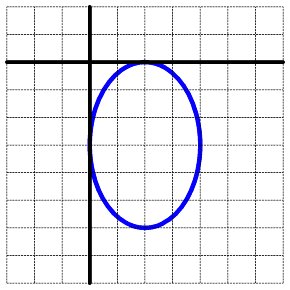
- Sketch the ellipse given by
(Supply your own x and y-axes.)
First we need to complete the squares. (Many of you still don't do this correctly.)
|
|
|
| |
|
| |
9(x2 - 4x + 4 - 4) + 4(y2 + 6y + 9 - 9) |
|
|
| |
9(x2 - 4x + 4) - 36 + 4(y2 + 6y + 9) - 36 |
|
|
| |
|
| |
|
| |
|
|
|
So the center of the ellipse is at (
h,
k) = (2,
-3) and the horizontal and vertical semi-axes are
a = 2 and
b=3, resp.
- For the ellipse below:
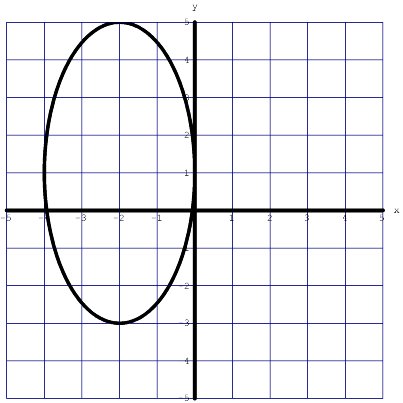
- Give the equation in standard form;
By inspection, the center is (
h,
k) = (
-2, 1) and the horizontal and vertical semi-axes are
a = 2 and
b=4, resp. So the equation is
|
|
(x + 2)2
4
|
+ |
(y - 1)2
16
|
= 1 |
|
- Give the coordinates of the foci. (pronounced fo-sigh, incidentally)
The distance
c from the ellipse's center to a focus is given by
|
c = |
Ö
|
a2 - b2
|
or c = |
Ö
|
b2 - a2
|
, |
|
whichever gives a real result (the first, if the ellipse is elongated horizontally, the second if vertically). In this case,
|
c = |
Ö
|
42 - 22
|
= |
Ö
|
12
|
= 2 Ö3. |
|
So the foci are at
|
(h, k ±c) = (-2, 1 ±2 Ö3). |
|
- An ellipse has a focus at (-1,1), center at (0,1) and passes through the point (2,1). Write the equation in standard form for the ellipse.
Drawing a crude picture helps.
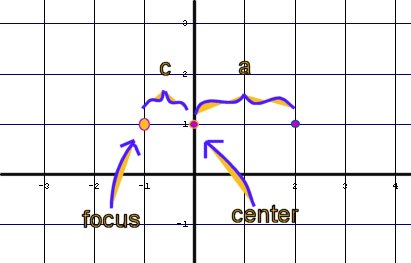
You can then see that
a=2 and
c=1, and so, since
c2 =
a2 - b2, we have
|
b2 = a2 - c2 = 22 - 12 = 3. |
|
Therefore,
- Find the focus and directrix of the parabola given by y = 2x2-4x.
I'll rewrite the equation in the standard "vertex" form:
So the vertex is at
We have that
p = 1/4
a, where
p is the distance from the focus to the vertex.
Here a = 2,
so p = 1/8. Therefore the focus is 1/8 unit from the vertex (above it, since
a > 0) at
|
(h,k+p) = (1, -2 + 1/8) = (1, -15/8). |
|
The directrix is
p units velow the vertex:
|
y = k-p = -2 - 1/8 = -17/8. |
|
- A parabola has its focus at the point (-3,2) and its directrix is the line y=6. Write an equation for the parabola.
The focus is below the directrix, so the parabola opens downward. The vertex is between the focus and directrix, so lies at
|
(h, k) = (-3, (2+6)/2) = (-3, 4). |
|
The distance from focus to vertex is (6
-2)/2 = 2 and this is the absolute value of
p. So
p =
-2, hence
a = 1/4
p =
-1/8.
The parabola's equation is
*** Extra Credit ***
Extra credit solutions or further hints available upon request.
- A.
- (*) Find a way to use synthetic division to do problem #2.
Hint: Use synthetic division once to divide by (
x+1) and write down what the result actually means:
Now you want to divide again by (
x+1), so divide the right-hand side of the equation obtained above...
- B.
- (*) Find all the zeros of 5 x3+4 x2-6 x+1
Some of you got this one. You try possible rational solutions and oneof them actually works. Use the quadratic formula after whittling the poly down with synthetic division.
- C.
- (*) Find a complex number a + b i not equal to 1, but whose cube is 1.
Hint: you want a number x such that x3 - 1 = 0. There are three solutions. x=1 is obviously one of them. The three solutions are called the "cube roots of unity."
- D.
- (*) Let f(x) = 2x-1. Find a function g such that g °g = f.
Hint: Make an educated guess as to the form of g, plug it into g(g(x)) = 2x-1 and solve for some unknown coefficients.
- E.
- (*) Find a function that matches the local behavior of the function f(x) of problem #2 at the point x=0.
Technically speaking, I didn't state this precisely, but we talked about in class. We want a polynomial of the form
that matches the local behavior. (The answer is 2
x2.)
- F.
- (*) Find a formula (piecewise will do) for the inverse of the function z(x) = 2x + |x-1|.
Suggestion: write the function in its piecewise form and consider inverting the pieces separately.
- G.
- (*) Find the distance from the point (1,3) to the line y=x.
(Done in class.)
- H.
- (*¼*) Ask a question you wish I had asked and
answer it. Points may vary. Offer void where prohibited by law.
File translated from
TEX
by
TTH,
version 3.02.
On 22 Nov 2001, 14:18.