 |
| Copyright the Mathematical Association of America |
Paul Deiermann and Rick Mabry, "The center of a sliced pizza", Mathematics Magazine, 68, no. 4 (1995), 312-315.
|
| Copyright the Mathematical Association of America |
1457. Proposed by Larry Carter, IBM Watson Research Center, Yorktown Heights, New York, John Duncan, University of Arkansas, Fayetteville, Arkansas, and Stan Wagon, Macalester College, St. Paul, Minnesota.
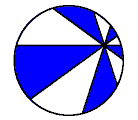
a. For a point P inside a circle draw three chords through P making six 60° angles at P and form two regions by coloring the six ``pizza slices'' alternately black and white. Prove that the region containing the center has the larger area.
b.* Prove that if five chords make ten 36° angles at P, then the region containing the center has the lesser area.
Solution by Paul Deiermann and Rick Mabry, Louisiana State University in Shreveport, Shreveport, LA 71115-2399.
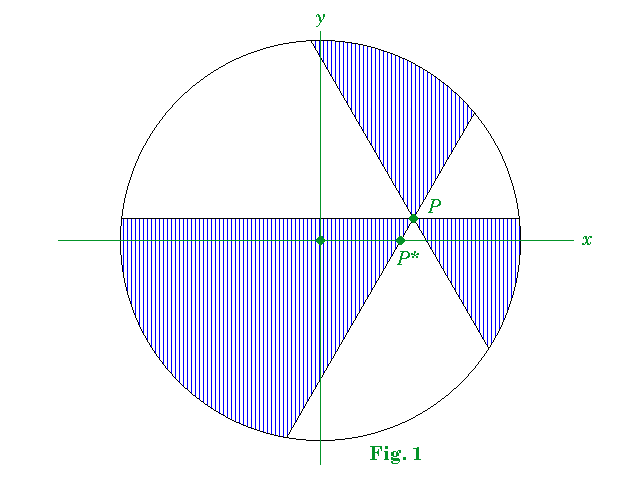
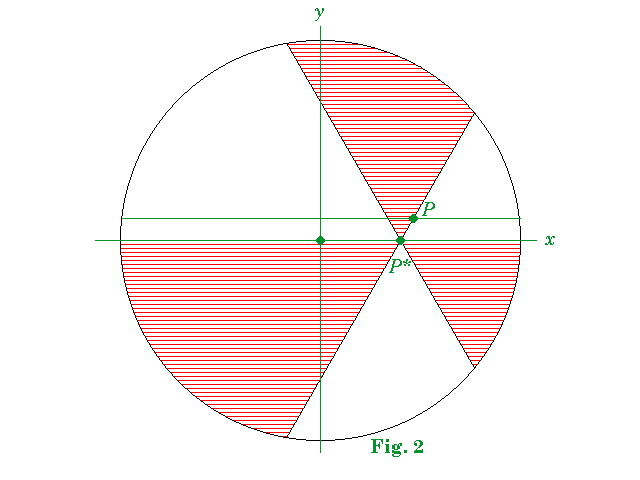
a. Our pizza is the unit disk. Without loss of generality, let P have polar coördinates (r,q), with 0 £ q < p/3, and let one of the cuts be parallel to the x-axis. (Any other configuration can be rotated into one like this.) We prove the result by showing that the region containing the origin, call it Â(|||) (the shaded region in figure 1), comprises no less than half the area of the pizza. (We will not always explicitly distinguish regions from their areas, it being clear from the context.) Let P* denote the intersection of the x-axis with the cut in the direction of p/3. Now take a fresh pizza and make cuts parallel to those on the first, but through P*. Then Â( º ), the region on the second pizza corresponding to Â(|||), is exactly one half of the pizza. (``Pie over two.'' See figure 2.) If Â(|||) is bigger than or equal to Â( º ), we're done.
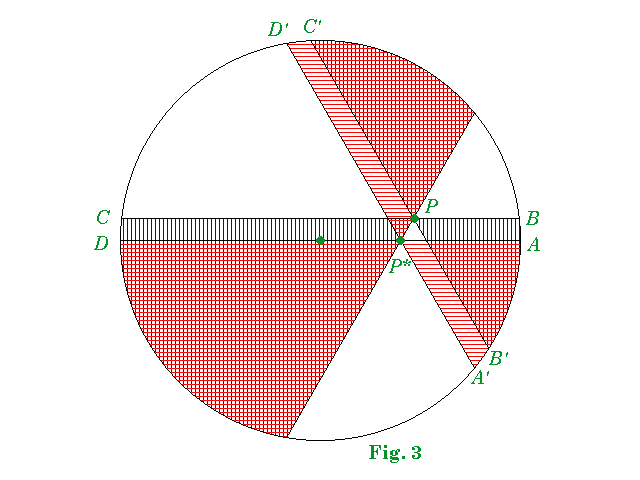
Overlay the two pizzas, as in figure 3. (This picture is the proof.) We disregard the doubly shaded regions, since they occur in both pizzas, and compare what is left, the two ``strips,'' ABCD and A¢B¢C¢D¢, minus their intersection. But the intersection, being common to both, can be ignored and we are left comparing the filled strips. These strips are of equal thickness, but ABCD is clearly the larger, since A¢B¢C¢D¢ sits at a greater distance from the center.
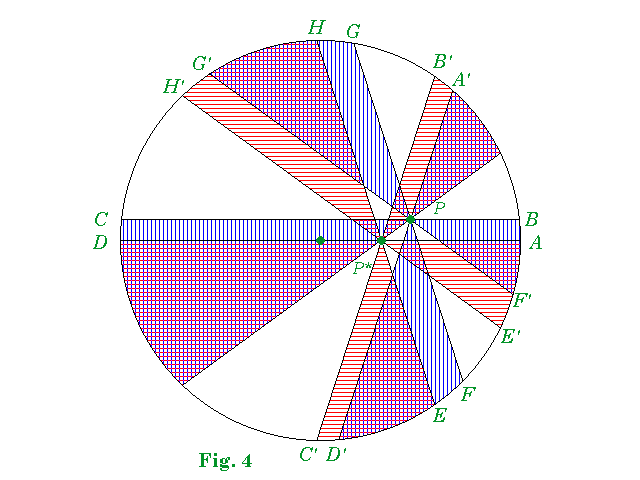
b.* Begin the same way as above, but restrict P so that 0 £ q < p/5, and let P* denote the intersection of the x-axis with the cut in the direction of p/5. Form the two pizzas and overlay them, as in figure 4.
Notice that the problem now amounts to comparing the sum ABCD+EFGH of the areas of the strips on the first pizza with A¢B¢C¢D¢+E¢F¢G¢H¢ on the second, plus or minus the holes or overlaps at the intersections - we need to be careful here, but we will show later that it suffices to consider the entire strips. This comparison is no longer trivial, as in part a., for although ABCD and A¢B¢C¢D¢ have the same ``width'', as do EFGH and E¢F¢G¢H¢, the ``lengths'' of these strips do not coöperate - ABCD is larger than A¢B¢C¢D¢ while EFGH is smaller than E¢F¢G¢H¢.
Let us delay the problem of the intersections for now, and show that
ABCD+EFGH £ A¢B¢C¢D¢+E¢F¢G¢H¢.
We need to find the area of a strip, by which we mean the difference of two
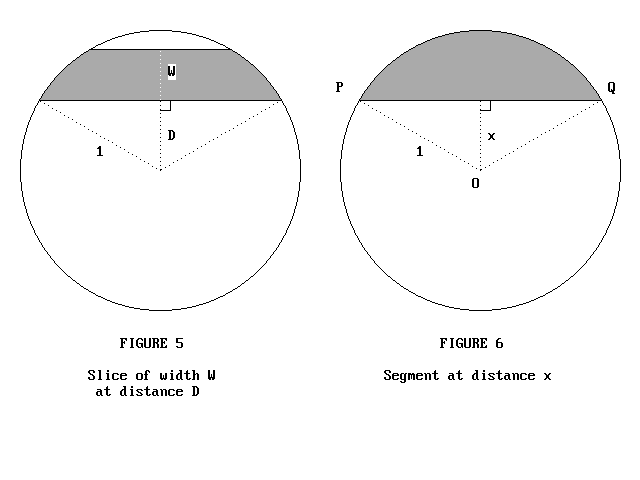
segments of the unit circle. Consider a strip at perpendicular distance D
from the center of the circle, and having width W, as in figure 5. Its
area is easily found to be s(D)-s(D+W), where
| s(x) = cos-1(x)-x | ____ Ö1-x2 |
Returning to figure 4, let d denote the distance from P to P* and w the distance from P* to the center, and let aj = jp/5, dj = dsinaj, wj = wsinaj, for j = 0,1,2. Let
|
|
| ||||||||||
| (1) |
Next we observe that
| s¢(x) = -2 | ____ Ö1-x2 |
| ||||||||||||||||||||||||||||||||||||||||||||||
| ||||||||||||||||||||||||||||||||||||||||
| (3) |
| ||||||||||||||||||||||||
| |||||||||||||||||
It remains only to show that DR = DS, that is, that we can justify ignoring the intersections of the strips. Let us associate the entire strips ABCD and EFGH with Â(|||), despite the fact that they have blank regions and Â( º )-regions, and similarly, associate the strips A¢B¢C¢D¢ and E¢F¢G¢H¢ with Â( º ). Then one may simply verify in each case that the regions in the intersections have the following properties.